Stage 3: Interview Letter (IL) Drops
Stage 3: Waiting for your interview letter. You are Documentarily Qualified and in the embassy scheduling queue; CEAC will still show “At NVC” until your Interview Letter arrives. Drops have stopped since 14 July 2026, so this is your best opportunity to get organized. Do this first: write your public charge statement, and check your tax documents are current.
Action list
- Beneficiary: Write the public charge statement, in consultation with your petitioner. Upload it to your case in CEAC, then email it to LNDIVSubmissions@state.gov.
- Petitioner: If the US tax filing deadline has passed since you reached DQ, upload the most recent tax transcript to CEAC.
- Beneficiary: Check your ACRO certificate and passport will still be valid: the passport for at least 6 months beyond your intended US entry date.
- Beneficiary: Check every police certificate you need is in hand and in date, including any from a country where you are a citizen but do not live. Australia’s takes up to two months.
- Beneficiary: Arrange health insurance to bridge the gap before arrival, and keep the quote or certificate for your statement.
- Beneficiary: When the IL arrives, book your medical with VisaMedicals and register on AIS, choosing your passport return method.
Reached a milestone in this section? Add your interview letter date to the community tracker →
After DQ, your case is complete at NVC and enters the embassy scheduling queue. This stage is a waiting and preparation phase. Your CEAC status will still show "At NVC" until your Interview Letter arrives.
Wait times from DQ to Interview Letter vary and change over time. See the data page for current community averages.
How IL drops work
The embassy schedules interviews in batches, not continuously. Batches are not on a fixed schedule, but until mid-2026 they arrived at least once a month, and occasionally more than once. Whether you receive an IL in a given batch depends on your DQ date relative to others in the queue. No batch has been reported since 14 July 2026. See below.
Based on 25 drops tracked by this community, March 2025 – July 2026. Updated 3 September 2026.
Drops follow a monthly rhythm. London releases one main batch of interview letters roughly every 4–5 weeks, with smaller top-up drops of a handful of letters in between. Each main drop fills about one calendar month of interview slots. The May 29 drop, for example, booked interviews across the whole of July.
They land on weekday afternoons, and look automated. No drop has ever arrived on a weekend. Nearly all appear between about 1:50pm and 4pm UK time, and the timing shifts by an hour when the clocks change: consistent with a system running on a fixed US morning schedule. One drop even landed on New Year's Day.
The queue is mostly first-come, first-served. Drops generally cover a recent block of DQ dates in order. But every third or fourth drop is a wide "catch-up" sweep that also picks up people who've been waiting far longer than average, so if you feel skipped, history says you're most likely to be picked up in one of those.
The wait from DQ to IL has grown. In summer 2025, letters were going to people DQ'd just 2–5 weeks earlier. By the final drop in July 2026 they were reaching DQ dates about 13 weeks old, and the average DQ-to-IL wait over the preceding six months was 77 days, up from 63 all-time. Anyone still waiting has been waiting longer than that since drops stopped.
The one dependable stage: IL to interview. Whatever month your letter arrives, your interview will almost certainly be two calendar months later. This held across the entire history up to July 2026, but it describes the date you are given, and interviews scheduled that way are currently being canceled. See the interview cancellation notice.
Right now: drops have stopped. The last one was on 14 July 2026 and it was small. By the usual pattern a larger drop was due in early-to-mid August; nothing came, and as of 3 September that is seven weeks of silence: longer than any gap in the 16 months above. Members waiting at other posts report the same, so this does not appear to be specific to London. Everything in this card describes how drops behaved up to 14 July. None of it is a forecast of when the next one will land, because we do not know that there will be one on the old pattern.
Based on the volume of data submitted, the tracker's IL drop figures reflect Immediate Relative (IR) cases: that's what nearly all of our members hold. Family-Sponsored Preference (F category) cases go through the same London process but are currently tracking about a month behind IR.
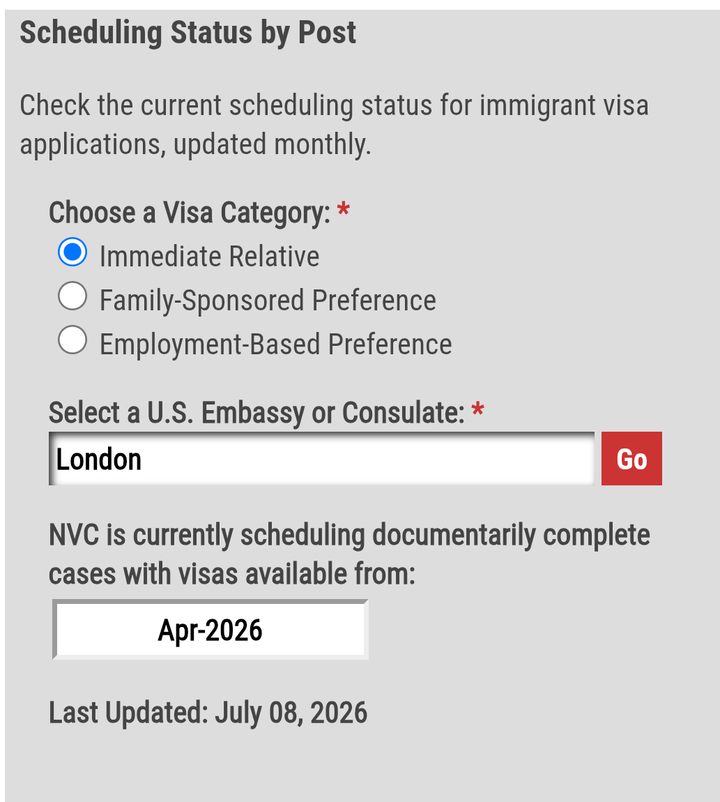
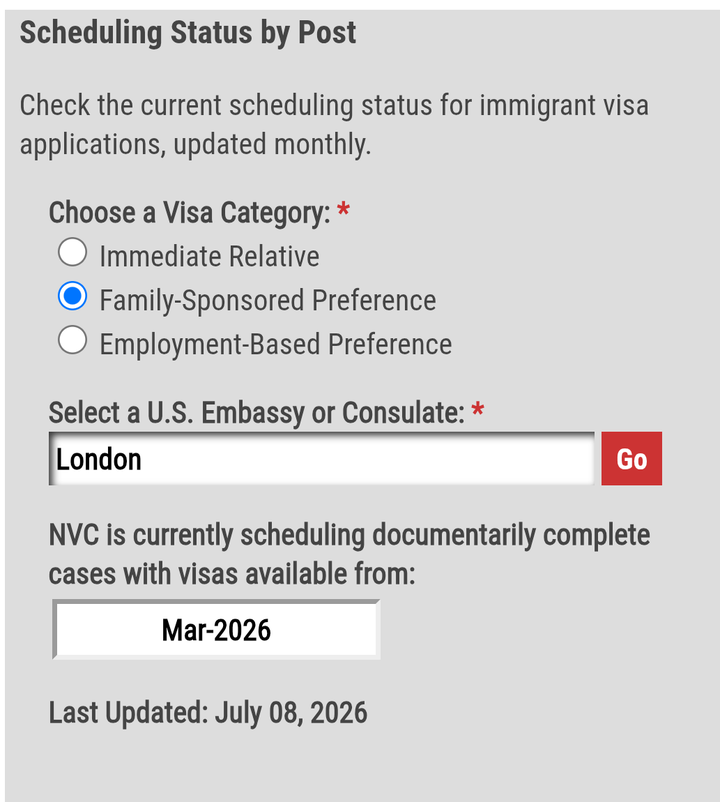
You can see this on the State Department's NVC immigrant visa scheduling status tool: as of its 8 July 2026 update, NVC was scheduling documentarily complete IR cases at London with visas available from April 2026, while Family-Sponsored Preference cases were at March 2026. Remember the tracker can only count the people who submit their information. Use the NVC tool for broader official scheduling data.
When do ILs arrive?
Based on observed London channel data, ILs arrive by email from National_Visa_Center@state.gov with the subject Immigrant Visa Interview Appointment, always on a weekday, typically early-to-mid afternoon UK time (around 13:50–16:00). Fridays are most common, followed by Wednesdays and Mondays, no drop has ever arrived on a weekend. A CEAC status update follows: it will show your case as being at the embassy.
Drop date, day, and time data is kept up to date on the data page: see the IL Drop History table there.
IL → Interview: observed pattern
Pattern observed from London community members. IL → interview is typically ~2 months.
What the IL email looks like
The Interview Letter arrives by email from National_Visa_Center@state.gov with the subject Immigrant Visa Interview Appointment, always on a weekday, typically early-to-mid afternoon UK time (13:50–16:00), most often Friday, Wednesday, or Monday. A CEAC status update follows.
Immigrant Visa Unit · Embassy of the United States of America · 33 Nine Elms Lane, London, SW11 7US
Dear [Beneficiary],
Case Number: LND01234567891
Interview: [TIME] [DAY], [DATE]
We are pleased to confirm that the Immigrant Visa Unit at the U.S. Embassy in London has received an approved petition in your name. To complete your application, you must attend two separate appointments at the U.S. Embassy:
- Document Review – Immediately following your medical examination
- Visa Interview – With an immigration consular officer
[Email continues with steps 1–4 and public charge statement. See the sections below, Stage 4: Medical exam and Stage 5: Embassy interview]
Actions after receiving your IL
1. Book your medical via VisaMedicals: appointment windows open monthly and fill quickly. The medical must be 10 working days before your interview date. You are required to attend the same-day embassy document check afterwards (window: 11:45 AM – 2:30 PM). Currently canceled: see the interview cancellation notice.
2. Register your interview via AIS. You must select your passport return method at this stage: home delivery or Mail Boxes Etc collection (Holborn, Angel, or Belfast). If you do not complete this, the embassy has no way to return your passport to you. Note: registration may take a few days to appear after the IL arrives.
Registration on AIS may take a few days after the IL arrives. If you have previously used AIS for a non-immigrant visa (e.g. B1/B2), you will likely need to create a new account for the immigrant visa process. Escalate after ~5 business days if unresolved: UK.Visas@gdit-gss.com
Check your financial documents are current
If you were DQ before the current tax year filing deadline, and your medical appointment and interview are scheduled after the tax filing deadline (typically April 15 in the US), your financials may be out of date. Consular officers need to review the most recent tax year to make a public charge assessment.
What to do: Unless you have filed a filing extension (in which case you can upload an explanation), update your tax documents in CEAC so that consular officers can review the latest tax year.
- Get your transcript: Visit the IRS Get Transcript portal to download your Tax Return Transcript for the most recent tax year. You will need to create or log into an ID.me account for secure access.
- Format your files: Save your tax documents as PDF or JPEG files. Each file must be smaller than 2 MB.
- Log into CEAC: Go to the CEAC Login Page using your Case Number and Invoice ID.
- Upload: Navigate to the Affidavit of Support section and upload the new tax transcript, along with any relevant W-2s or Schedules, as supplemental or updated financial evidence.
Getting an ID.me account
The IRS now requires all users to verify identity through ID.me. This is a secure identity verification service used by multiple US government agencies.
- Visit id.me and click "Sign up"
- Choose to verify with your IRS account or use your driver's license, state ID, or passport
- Follow the identity verification prompts. You may need to take a selfie and photos of your ID
- Once verified, you will have instant access to the IRS Get Transcript tool
- Download your Tax Return Transcript and upload it to CEAC as described above
Use the waiting time to prepare
This period is your best opportunity to get organized before things accelerate. Make sure all of these are current and start to organize your binder.
- Ink fingerprints on paper only. The AFP does not accept digital prints, and it needs full palm and side prints as well as fingertips. Few UK providers still take ink prints: one member had to travel to London for them.
- Confirm the form first. Members who phoned the AFP to check which form to use found them helpful, and were sent the right form by email.
- Post tracked, but expect silence. Tracking shows nothing until the envelope reaches the AFP office in Australia, and there may be no delivery confirmation at all. The fee being taken is your confirmation it arrived. One envelope was held at the Australian border because it contained fingerprint material.
- Timelines reported: one day under a month start to finish, with the certificate issued 10 working days after the AFP received the prints (faster than the minimum its website quotes); and 57 days for another member: posted 9 June, delivered 2 July, digital certificate 16 July, physical certificate 5 August.
Two separate trips required: one for the medical + document check, one for the interview. These cannot be combined unless you have an expedited interview.
The most common reason a London case stalls at the window is a financial gap that was fixable during exactly this waiting period: a missing IRS transcript, income near the threshold with no joint sponsor lined up, or out-of-date tax documents. Our 221(g) page sets out the planned mitigations to lock down now, before your interview.
How to prevent a 221(g) →Public Charge: prepare your written statement
The public charge assessment is a demonstration of intent and planning. The officer wants to see that you have thought about how you will support yourself in the US to ensure that the beneficiary won't become a burden on the U.S. government.
The rules driving this section are not published. The November 2025 cable has never been released, nor has the worksheet officers now work through. What follows is assembled from practitioner analysis, court filings, materials posts have given to applicants, and reports from people who have been interviewed. That is a lot of convergent evidence, but it is not a published standard, and we have no confirmation that this is exactly what to expect. London in particular has barely tested it: interviews were cancelled through 30 September 2026 for the training programme that produced these changes.
What is reasonably clear is the direction of travel. A worksheet at every post, mandatory officer training and expanded managerial review all point toward a more uniform and more searching assessment becoming the ordinary worldwide standard rather than a passing burst of scrutiny. Expect the detail to keep moving and parts of this to need rewriting. Prepare for the version described here anyway: it costs an afternoon, and arriving without it costs a 221(g) and months. Full caveat and sources: the public charge page.
The assessment used to rest almost entirely on the petitioner's income and the I-864. That is no longer the whole picture. The statute behind it, INA 212(a)(4)(B), requires the officer to consider five minimum factors, and every one of them is about the beneficiary:
- Age: applicants at advanced age, and at the other end under 16, are expected to show credible plans for support. Officers weigh whether you can work long enough to fund your own retirement and avoid expensive long-term care, so pension provision and household resources matter. Posts also ask the petitioner’s age, because a sponsor near retirement has fewer working years left to deliver the income the I-864 promises.
- Health: taken from the panel physician's report and any Class B certification. Chronic or high-cost conditions: cardiovascular disease, diabetes, cancers, neurological disorders, serious mental health conditions: are assessed against your ability to fund lifelong care without public assistance. Officers are not confined to the report; visible risk factors, obesity among them, are named in the guidance. If you plan to rely on an employer’s plan, expect the officer to weigh how likely you are to obtain and keep such a job, and how you would stay covered after retiring. Expect the question to be about cost, not just coverage: officers have asked applicants what their own medication costs in the US. Price yours before you go.
- Family status: your household size, and who depends on whom. Minor children, elderly parents and other dependents can weigh against you. Even with no dependents, the officer gauges whether you will be able to care for yourself as you age rather than needing government-funded residential care. Two sub-questions catch people out. Posts ask whether any of the petitioner’s dependents have a medical condition under treatment, or a disability or special need requiring long-term care, because those draw on the same income meant to support you. And they define dependents more widely than Form I-864 does: all of them, including extended family or friends the petitioner supports financially, who appear nowhere on the affidavit. Work out both numbers and be ready to explain the difference.
- Assets, resources and financial status: household income first and foremost. Savings and property are counted, and debts set against them, but see the warning below: at London, assets do not stand in for predictable income. Where they do carry weight is resilience: officers look for liquid, documented assets that could absorb a job loss, a medical emergency or long-term care, and may ask for bank records, retirement accounts and life insurance, and verify them independently.
- Education and skills: degrees, certifications, licenses, and skills gained through work experience, including unpaid and volunteer work; formal education is not the only acceptable evidence. At post this factor carries an extra edge. English proficiency is treated as central, interviews are conducted in English wherever possible, and for a non-native speaker the officer estimates how long fluency would take. Officers also weigh whether your qualifications will be recognized in the US, and whether relicensing requirements stand between you and work in your field. Have both histories as lists, not sentences: every position title with the years worked, and every qualification with subject, institution and year. Posts request them in exactly that form.
The I-864 is weighed alongside these, not instead of them: a sufficient I-864 no longer ends the inquiry. It cuts the other way too, and sharply: where an I-864 is required, failing to produce a sufficient one is the single thing that sinks a case on its own. Every other factor is weighed in the round, and no one of them decides the outcome by itself.
This shift is documented, not just anecdotal. The State Department is not bound by the USCIS reading. It works from its own manual, 9 FAM 302.8, but a November 2025 cable to all consular posts substantially expanded the factors and evidence officers apply to immigrant visa applicants, and puts the burden squarely on you to show affirmatively that you will not become a public charge at any time after admission. Community reporting from London matches: this questioning is now routine at the window. See CLINIC’s analysis. Our statement template covers all five factors.
The assets factor is real, but do not read it as an opening. Savings, property equity and investments strengthen a case that already has predictable income behind it; they do not replace it. London has refused cases resting primarily on assets even where the I-864 multiplier was met on paper. See Asset-based sponsorship risk at London in the NVC section.
Write the statement so recurring, predictable income answers "how will this be paid for" in every section. Put assets at the end as a contingency buffer. If income is short or near the threshold, get a joint sponsor lined up rather than leaning on assets.
Officers are not limited to US federal means-tested programs. The November 2025 cable is reported to direct officers to consider any form of public assistance, social welfare, or private charity intended to help low-income people, whether provided in the United States or in any other country. That cable has not been published, so this rests on practitioner reporting rather than a source you can read. Means-tested UK benefits such as Universal Credit, Housing Benefit and Council Tax Support, and their equivalents elsewhere, are in scope, and a dependent’s receipt may be considered too.
Benefits that are not means-tested are not public benefits for this purpose. If eligibility does not depend on your income or savings falling below a threshold, the benefit is not itself a public charge concern. That includes earned and work-related benefits and support paid regardless of income: the State Pension, Child Benefit, Personal Independence Payment, Statutory Maternity Pay, and New Style Jobseeker’s Allowance or ESA.
That is not the same as the benefit being irrelevant. Health is a separate statutory factor and is assessed in its own right. A benefit that exists because of a disability or a long-term condition, PIP being the clearest example, tells the officer about that condition even though the payment itself is not a public charge issue. If this applies to you, do not leave it out: prepare how the condition is managed, and who pays for that care in the US.
This is not a reason to conceal anything. Answer every question truthfully: a misrepresentation is a far graver problem than benefit receipt, and receipt is not disqualifying on its own.
What helps is context: if you have claimed a means-tested benefit, when, why, how long, and what changed. A redundancy since resolved, a period of illness, a drop in household income during maternity leave: a short factual explanation lands far better than a surprised silence at the window. The template has a section for it.
Charity counts, and so does the petitioner. Written questionnaires give food banks as an example alongside government programmes, and ask about the petitioner and the beneficiary in the same sentence, across both current and prior receipt. A food bank is not a government benefit, but it is support for people on low incomes, which is the class the cable is reported to reach. Answer the question as asked rather than arguing with its categories.
Public charge has two limbs, and almost all guidance covers only the first. Alongside dependence on means-tested support sits long-term institutionalization at government expense, which has been part of the definition for decades. Written questionnaires ask it as a numbered question of its own: has either the petitioner or the beneficiary ever been institutionalized at government expense, a long-term stay in a mental health facility or a nursing facility being the examples given.
For a UK applicant this is not the NHS. Ordinary NHS treatment is free to everyone, is not means-tested, and is not institutionalization for long-term care. What the question reaches is a prolonged stay in a facility funded by the state because you could not fund it yourself: a local-authority-funded care or nursing home place, NHS continuing healthcare funding a residential placement, a long-term inpatient stay under the Mental Health Act and s.117 aftercare, or long-term residential care for a disabled adult or child. A short hospital admission is not this.
Where something does fall within it, handle it exactly as a benefit history: dates, reason, what changed, and the position now. A resolved episode explained plainly is a far smaller problem than one the officer finds in the medical report having not found it in your statement. Full detail and template wording: public charge, section 6.
Clearing 125% of the Federal Poverty Guidelines gets the affidavit accepted. It does not settle the public charge question. Officers look behind the figure at the sponsor’s financial stability and history rather than just the latest return, the sponsor’s own use of public benefits, the genuineness of the relationship and whether the sponsor is realistically likely to make that money available to you, and whether the affidavit plausibly keeps you off public support for life.
Joint sponsors face heightened review: employment, assets and domicile may all be verified. And the NVC document review does not bind the consular officer: clearing NVC means your paperwork was complete, not that your finances were accepted. Cases pass NVC and still draw a 221(g) at London on exactly this ground.
Five things now asked about a joint sponsor, and the beneficiary answers them, not the sponsor: how you are related, described rather than labelled; how long they have known the petitioner and you; whether they live in the same state as the petitioner; whether they have sponsored anyone else for an immigrant visa; and whether they have ever used public assistance. The fourth has arithmetic behind it, not just curiosity: an unterminated I-864 obligation from an earlier case counts toward their household size on yours, raising the income they must show. Check it before you file. See the household decision tree and public charge, section 7.
This guide covers consular processing: a DS-260 and an interview at an embassy abroad. If you are adjusting status inside the United States on Form I-485, the guidance above is not written for you: adjustment is decided by USCIS under its own published guidance (Policy Manual Volume 8, Part G), which takes effect on 18 September 2026 for applications postmarked or filed electronically on or after that date, and which states in terms that it does not apply to people applying for immigrant visas through the Department of State. See USCIS: Guidance on Making Public Charge Inadmissibility Determinations, the USCIS Policy Manual, and USCIS Expands Public Charge Discretion: the Catholic Legal Immigration Network’s practitioner analysis, which covers the USCIS changes and the separate State Department position side by side.
Treat the written statement as a required document. Submit it before your interview by uploading it to your case in CEAC first (log in at ceac.state.gov/IV and use the SUBMIT DOCUMENTS option, in red at the bottom of the page), then emailing it to LNDIVSubmissions@state.gov so the unit knows the upload is there. Both, in that order, at least five working days ahead: the upload puts the document in your case file, the email makes sure someone looks. The embassy's messaging may describe this statement as something applicants may voluntarily submit. Do not treat it as optional. Community experience is consistent that you should prepare it, send it, and bring a printed copy regardless of how the embassy frames it. See our sample template →
The statement raises specific questions the officer may ask the beneficiary at the window. Whether or not each detail is written into the statement, the beneficiary should be able to answer all of the following out loud, consistently with what was submitted:
- What does the petitioner do for work? Job title, employer, and roughly what they earn.
- What does the joint sponsor do for work? Where a joint sponsor is required: their job title, employer, and roughly what they earn.
- What will the beneficiary do for work in the US? The intended role or sector, and whether a job is lined up or will be sought after arrival.
- What is the plan for the beneficiary's health insurance? Coverage before and after arrival: a spouse/family employer plan, a private/short-term policy, or the ACA marketplace.
- What is the plan for the beneficiary's housing? A confirmed address, or the area and timeline if not yet secured.
- How will the health insurance and housing be paid for? Which income covers the premiums and the rent/mortgage during any period before the beneficiary is earning.
- What are the estimated salaries? Roughly what the beneficiary expects to earn in the US, compared with what the petitioner and/or joint sponsor earns.
- What is the beneficiary's education and work history? Highest qualification, and how long they have worked in their field: continuity matters as much as the current role.
- Does the beneficiary have savings? Roughly how much is available to draw on during the transition, separate from the sponsor's income.
- Does the beneficiary have any ongoing health condition? If so, how it is managed and, crucially, who pays for that care in the US.
- Who else depends on the household? Any children or other dependents traveling with, or already in, the household, plus anyone the petitioner supports financially who is not a tax dependent. Expect “who else lives at the address?” as a separate question.
- Why was the sponsor’s income low in any given year? Officers read the tax transcript in front of you and ask the beneficiary to explain a weak or below-threshold year, and what happens if the cause of it recurs. Know the reason and know what changed.
- If the sponsor is self-employed: what is the business, and what if it fails? The contingency question is asked directly. Have an answer.
- Is the sponsor’s job unionised? Do they have a mortgage? Union membership and employer benefits speak to job security and health coverage; the mortgage is the largest of the debts the officer weighs.
- Is your own work remote, and will your employer permit you to work from the US? And if not, what is your plan? Do not assume a remote job survives the move: many employers will not allow it, for tax and payroll reasons. Get written confirmation if you are relying on it.
- What does your treatment cost in the US? Asked in those terms, not just “are you insured”. Price your own medication in dollars before you go.
- Can you prove the assets you have named? Officers ask to see a savings balance and proof of each property claimed, co-owned ones included. Bring printed evidence for everything you assert, or do not assert it.
The statement doesn't need to be long or formal. A short, direct account of your housing, employment, and insurance plans, and how each is paid for: is sufficient. The officer wants to see that you have a plan.
A qualifying I-864 is necessary but no longer sufficient on its own. The sponsor's income is the starting point, and the beneficiary's own circumstances are assessed alongside it. An insufficient one, where it is required, remains the single failure that decides a case by itself. More info: travel.state.gov: Preventing Public Benefits Reliance. For the twenty numbered questions posts now issue in writing, the document list a public charge 221(g) generates, and a full account of a 35-minute London public charge interview, see the public charge page
Health insurance: the coverage gap
There are two periods to plan for:
Before you arrive. Your US health insurance options typically don't begin until you are resident in the US and able to enroll. Short-term international health insurance can bridge this gap. Community members have used:
- Cigna Global: offers an online quote in a few minutes at cignaglobal.com. No commitment to purchase. The quote summary is a downloadable PDF you can include with your public charge statement as evidence that you have researched coverage.
- IMG Patriot America Plus: community members have obtained 6 months of coverage without needing a US SSN. IMG will issue a certificate of coverage, which can be included in your public charge statement.
These are community-reported examples only and are not recommendations. Research plans to find what suits your situation.
After you arrive. Once you are a permanent resident living in the US, you are eligible to enroll through the ACA marketplace at healthcare.gov. Plans are available at a range of price points and many people qualify for tax credits that significantly reduce the monthly premium. You can browse plans before you arrive so you know what to expect.
Get your quote or certificate of coverage before your medical appointment and bring a printed or digital copy to both your medical and your interview. If you are submitting a public charge statement to LNDIVSubmissions@state.gov ahead of your interview, include it there too. You are not required to have purchased a policy. A quote demonstrating you have researched and budgeted for coverage is sufficient. One exception worth considering: if you have an ongoing condition that will come up at your medical, actual confirmed coverage answers the "who pays for that care" question far better than a quote does.
Can the petitioner come to the medical or the interview? The two are different. Not the embassy: petitioners are not permitted inside the US Embassy for either the document check or the interview. The beneficiary attends alone; the only exceptions are an interpreter, or one accompanying person for a visitor with special needs. The medical is more flexible: Visa Medicals will allow a companion to wait, which is worth arranging if you need someone to mind children. Pre-arrange it with the clinic by email, roughly a week ahead. Set expectations, though: the waiting area is small and gets very hot, and the building is not step-free, so a pram needs assistance.
Do I need the original I-864 mailed to me? No. A printed copy is sufficient.
Do I need two separate trips to London? Unless you have an expedited interview, everyone makes two separate trips: one for the medical and document check, one for the interview. There is no exception for distance or cost. Plan accommodation and travel well in advance.
Expedited interviews
Expedited interviews are available in genuine emergency situations such as serious medical need. They are not a workaround for queue position. Community data shows 4 expedited cases. These are excluded from wait time calculations as they are not representative of the standard process.
To request: email NVCexpedite@state.gov
↑ Back to topBefore you move on
- Beneficiary: My public charge statement, agreed with my petitioner, is uploaded to CEAC and emailed to LNDIVSubmissions@state.gov.
- Petitioner: CEAC has the most recent tax year’s transcript for every sponsor.
- Beneficiary: Every police certificate I need, including from any country of citizenship I do not live in, is in hand and in date for my interview.
- Beneficiary: I can answer the public charge questions out loud, consistently with the statement.
- Beneficiary: My IL has arrived, and my medical is booked at least 10 working days before the interview.
- Beneficiary: My AIS registration is complete, with a passport return method selected.